
The link between grip strength and athletic performance
Why does grip strength matter? Grip types for athletes, testing, training methods and grip strength as a health marker.
Grip strength isn't treated as a separate topic in most programs. Yet in many sports it directly limits performance, and it's also one of the most practical indicators of overall health and strength.
Three grip types
- Crush grip: Squeezing between the fingers and palm. The type measured with a hand dynamometer and grippers.
- Support grip (hanging/carrying): The ability to hold a load for a long time. Decisive in deadlifts, pull-ups, farmer’s carries, wrestling and climbing.
- Pinch grip: Holding between the thumb and the other fingers. Plate pinches, gi gripping.
Support grip is the type most needed in athlete programs; but in combat and climbing sports, pinch grip also becomes critical.
In which sports is it decisive?
- Wrestling, judo, BJJ: Grip fighting shapes how the match unfolds; gi grip endurance directly produces results.
- Climbing: Finger strength is at the heart of performance.
- Racket sports: Racket control at impact and forearm endurance.
- Rowing, weightlifting, powerlifting: Holding the bar can be the limiting factor.
- Rugby, American football: Grabbing and pulling actions.
Grip as a health marker
Grip strength measured with a hand dynamometer has been linked in epidemiological studies to overall muscle strength, functional capacity and long-term health markers. This isn't because grip strength has some magic property, but because it's an easily measured proxy for overall strength. Still, it's a practical tool for regular monitoring.
How is it measured?
- Hand dynamometer: Elbow at 90 degrees, arm close to the body; 3 attempts per hand, the best is recorded.
- Dead hang time: Maximum hang time on a bar; simple and effective for support grip endurance.
- Farmer’s carry distance: The distance you can carry a given weight.
As a reference, dynamometer values of 50–65 kg for adult male athletes and 30–45 kg for female athletes are common; they vary significantly by sport.
Training methods
Support grip
- Farmer’s carry: 20–40 m with heavy dumbbells or kettlebells, 3–4 sets. Also works trunk stability.
- Dead hang: Hanging from a bar, 3× max time. Also beneficial for shoulder health.
- Towel pull-ups or towel hangs: A stimulus similar to gi gripping for combat athletes.
- Strapless deadlifts: Doing some of your sets without straps.
- Fat grip attachments: Increase grip demand by thickening the bar.
Crush grip
- Gripper work: 3×5–8 reps, gradually increasing resistance
- Heavy dumbbell holds
Pinch grip
- Plate pinch (carrying two plates held by their flat sides)
- Pinch block hangs
Forearm balance and elbow health
Intensive grip work can make the forearm flexors dominant and set the stage for elbow complaints (especially medial epicondylalgia). Extensor work is added for balance: wrist extensions, finger extension resistance bands, reverse wrist curls. For racket athletes, this balance work should be part of the standard program.
Programming
- Frequency: 2–3 times a week, in short blocks.
- Placement: At the end of the session. Grip fatigue lowers the quality of the main lifts.
- Volume: A total of 5–10 minutes is enough.
- Caution: In grip-intensive sports like climbing, total load should be carefully monitored; finger tendons adapt slowly.
Is using straps cheating?
No, it's a choice of tool. If the goal is to train the posterior chain with maximum load and grip is the limiting factor, using straps makes sense. Grip is trained separately with targeted work. But using straps on every set completely stalls grip development; the balanced approach is to go strapless on warm-ups and moderate sets and use straps on the heaviest sets.
Frequently asked questions
How long does it take to improve grip strength?
With regular training, a significant increase is seen in 6–8 weeks; tendon adaptation takes longer.
Can I use a gripper every day?
Not recommended; the forearms and tendons need recovery time. 2–3 sessions a week are enough.
I have elbow pain — should I do grip work?
In the acute phase, reduce volume and focus on extensor work; if it persists, see a physiotherapist.
Is hanging good for the shoulders?
A controlled dead hang benefits shoulder mobility and scapular control in most athletes.
Related articles.
Sled sprints and resisted acceleration training
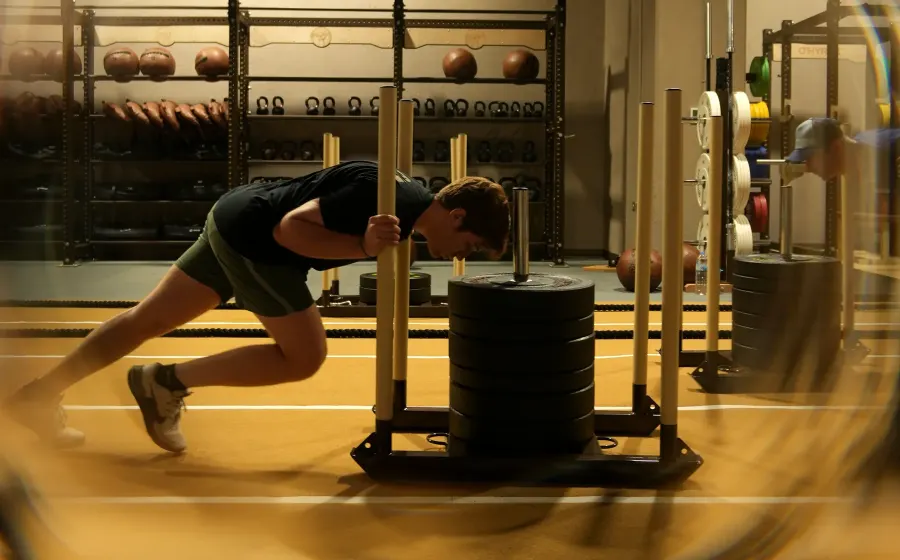
Resisted acceleration training with a sled: load selection, the velocity loss method, a technique checklist, the distance-reps-rest balance and a sample session.
Kettlebell swings and hip extension power
A guide to kettlebell swing technique, hardstyle vs. Russian style, hip extension power and programming.
Deadlift technique guide: conventional or sumo?
Deadlift technique: conventional or sumo? Setup, the pull, common mistakes, lower back health and variation selection for athletes.
