
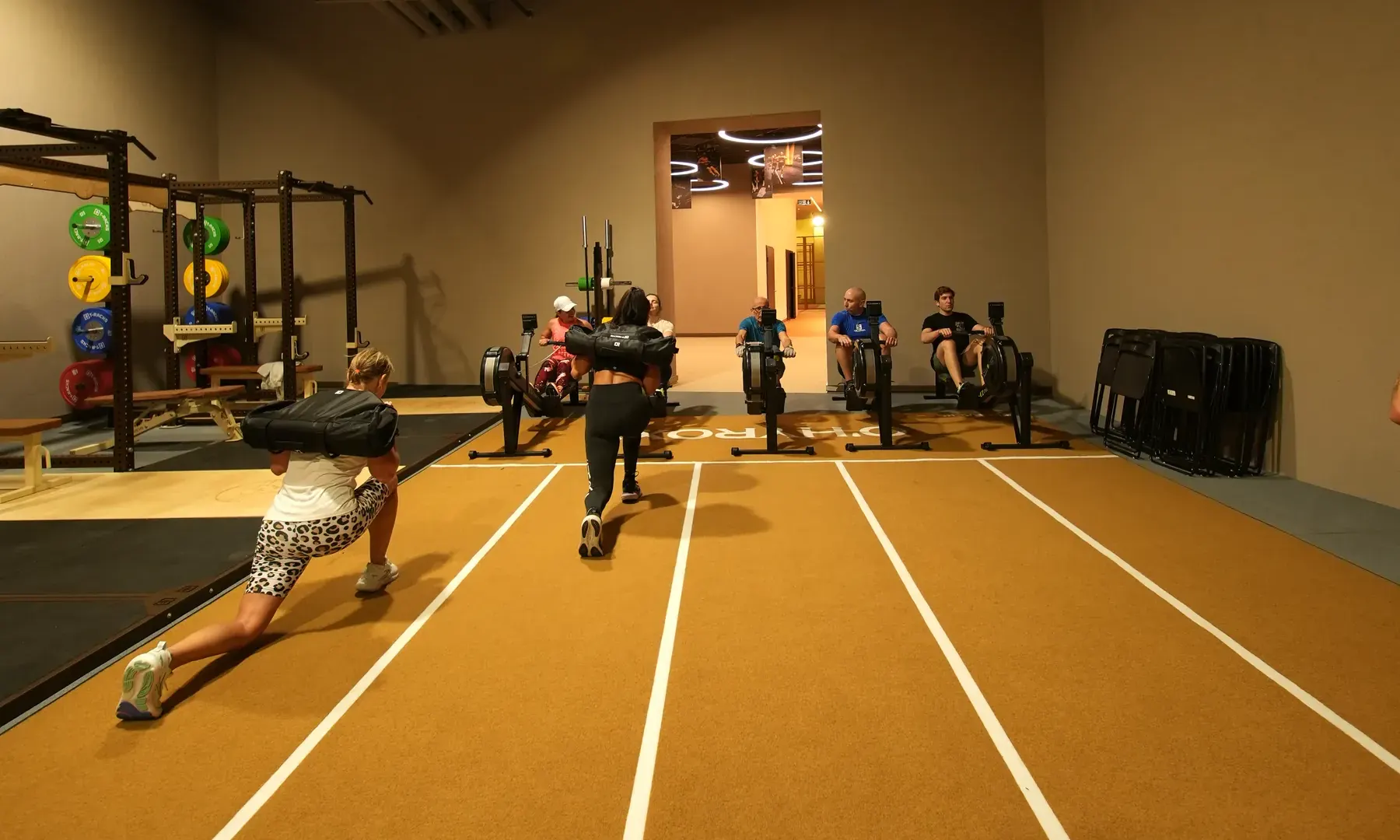
Agility and change-of-direction training: planned and reactive work
The difference between planned and reactive work in agility and change-of-direction training, braking mechanics, the strength base and a sample weekly block structure.
Agility and change-of-direction training, is one of the most talked-about yet least systematically trained topics in team-sport performance. Whether a player gets past an opponent, stretches for the ball at the last moment, or takes up a defensive position depends less on how fast they run in a straight line and more on how quickly they can cut their speed and produce it again. At O’Athletic Sky in Skyland Sarıyer, we treat this as two separate abilities: turning toward a known direction (planned agility) and changing direction in response to an external stimulus (reactive agility).
This distinction matters because the two skills develop through different mechanisms. The first is driven mostly by mechanics and strength; the second by perception, decision-making and visual scanning. Training only one of them in a program is usually not enough to create a visible difference on the field.
What is agility, and what is change of direction?
In the literature, agility is defined as the ability to change speed or direction in response to a stimulus. The critical word here is “stimulus.” If the athlete knows from the start where to turn, the task is technically planned change of direction (change of direction, COD). Almost all the classic drills done on cone patterns fall into this category.
True agility, on the other hand, includes a decision component: the athlete reads a movement, a light, a ball or an opponent and reacts accordingly. The same athlete can score very well on planned tests yet slow down markedly on reactive ones. This gap is one of the clearest signals of where training should be invested.
What the two components look like in practice
- Planned COD: braking capacity, single-leg strength, foot-plant mechanics, trunk control.
- Reactive agility: visual scanning, early detection of the stimulus, decision time, recovering quickly from a wrong decision.
The mechanics of changing direction
A change-of-direction movement can be examined in three phases: deceleration, transition and re-acceleration. Most athletes are good at the third phase; the problem usually lies in the first two. A player who cannot cut speed in a controlled way has to take an extra step to turn, which wipes out advantages measured in tenths of a second.
In the deceleration phase, the eccentric capacity of the quadriceps and hip muscles is decisive. In the transition phase, ankle stiffness, knee alignment and the trunk's lean angle toward the turning direction come to the fore. As the angle grows (for example, the difference between a 45-degree cut and a 180-degree turn), the braking force required, and therefore the load on the joints, also increases.
Common technical errors
- Planting the foot too far in front of the body line on the turning step, which lengthens braking time.
- Staying upright; on the turn, the trunk should lean slightly toward the target direction.
- Knee collapsing inward; this both reduces performance and disrupts load distribution.
- Passive arms; arm movement is an active tool for balance and acceleration on the turn.
- Fixing the gaze on the ground; on the field, the gaze should gather information for the next decision.
Agility does not develop without a strength base
Most agility work does not deliver the expected result when applied as “set up cones and run fast.” That is because changing direction is about producing high force in a short time and, more importantly, absorbing high force. For this reason, at O’Athletic Sky we always build the agility block on top of a strength base.
The core elements of this base include single-leg squat variations, split squats, hip-hinge movements and hamstring work with an eccentric emphasis. Alongside these, landing and stopping exercises that directly target braking skill are added: simple but demanding tasks such as jumping off a box and landing quietly, or coming to a full stop in two steps at a signal while running.
A sample braking progression
- Weeks 1-2: landing mechanics in place, controlled stances on both feet.
- Weeks 3-4: approaching by walking and light jogging, then stopping on a single foot.
- Weeks 5-6: 45-degree cuts at submaximal speed, few reps with a technical focus.
- Weeks 7-8: 90- and 180-degree turns at high speed, followed by reactive tasks.
How to move into reactive training
Reactive agility comes into play once the mechanics are well established. Otherwise, the athlete is forced to make decisions at a speed at which they cannot apply the correct technique. The transition is usually made by gradually making the stimulus more complex.
At the simplest level, the coach shows the direction by hand. Then the athlete begins to read the coach's body movement. Later, a ball, a light system or an opponent is added. In the final stage, small-sided games and position-specific scenarios are used; here, agility is no longer an isolated exercise but a quality measured within the game.
Keep volume low in reactive sessions. Decision-making fatigue builds up faster than muscle fatigue, and as soon as quality drops, the work strays from its purpose. Usually 6-10 reps with plenty of rest between reps provide a sufficient stimulus.
Fitting it into the weekly program
Because agility work taxes the nervous system heavily, it is placed at the start of the session, right after the warm-up. Change-of-direction work done with a tired athlete neither produces progress nor reinforces technical errors.
Two agility blocks in a typical week are enough. One can be planned and technique-focused, the other reactive and game-like. As match day approaches, volume is reduced but not removed entirely; a short, sharp reactive block helps prepare the athlete for match rhythm.
A sample agility block
- 10-12 minute warm-up following RAMP principles.
- Low-intensity landing and stopping drills: 2 sets, 4 reps.
- Planned cutting work (45 and 90 degrees): 2 sets, 3 reps in each direction.
- Reactive task (coach signal or ball): 6-8 reps.
- Finish with short mobility and breathing work.
Measuring beats guessing
Simple tests are enough to track progress. The 5-0-5 test measures turning ability, the T-test measures multidirectional movement, and light-based reactive tests measure decision time. What matters is repeating the test under the same conditions every time and monitoring the gap between planned and reactive scores. If this gap closes over time, the reactive work is doing its job.
When working with amateur and licensed athletes training around Sarıyer and Skyland, the picture we see most often is this: an athlete profile that is fast in a straight line but hesitant on turns. This profile can change markedly with a strength and agility program planned in the right sequence. If there is pain or a previous injury, the best step is to get an assessment from a healthcare professional before starting the program.
What makes a difference on the field is often not a new exercise, but the same exercises applied in the right order, at the right volume and with measurement. At O’Athletic Sky, we build the agility program on this logic, according to the athlete's sport and position.
Related articles.

Adductor Strength and Groin Health: A Program That Starts with the Copenhagen Plank
The inner thigh muscles work constantly in cutting, kicking and sliding movements yet are often forgotten in programs. We explain the Copenhagen plank and its progressions.
Kettlebell swings and hip extension power
A guide to kettlebell swing technique, hardstyle vs. Russian style, hip extension power and programming.
Deadlift technique guide: conventional or sumo?
Deadlift technique: conventional or sumo? Setup, the pull, common mistakes, lower back health and variation selection for athletes.
